Self-Controlled Designs Guide
Introduction & Purpose
Self-Controlled Designs are a unique and powerful class of study designs used primarily for safety surveillance. Their key feature is that individuals serve as their own control. This elegantly addresses confounding by baseline patient characteristics, as these factors (e.g., genetics, chronic conditions) are inherently constant within the same person over time.
The purpose of these designs is to investigate whether there is an increased risk of an acute event immediately following a transient exposure, such as a vaccination or a short course of medication. The central question is: “Is the risk of the outcome higher during the ‘exposed’ period compared to the ‘unexposed’ period within the same individual?”
Study Designs
This category includes two main, closely related designs:
- Self-Controlled Case Series (SCCS): This is the classic design. It includes only individuals who have experienced the outcome of interest (i.e., “cases”). It then compares the rate of the outcome during periods of exposure to the rate during all other observed time periods.
- Self-Controlled Case Risk Interval (SCRI): This is a variation that defines a specific, pre-specified “control interval” relative to the exposure date. It compares the risk in the exposed window to the risk in this defined control window, rather than all unexposed time.
Participants
The study population consists of individuals who have experienced the outcome of interest at least once. For this reason, the design is often described as a “case series.” Additional eligibility criteria can be applied based on demographics or clinical history.
Exposures
The exposures in these designs are typically transient and have a clearly defined start and end. The classic example is a vaccination. The time immediately following the exposure is defined as the “risk window.” All other time is considered the “unexposed” or “control” window.
Outcomes
The outcomes must be acute events where the exact date of occurrence can be accurately determined. Chronic conditions with an insidious onset are not suitable for this design. The outcome should also not be something that would alter the probability of future exposure (e.g., an outcome that is a contraindication to receiving the drug again).
Follow-up
The observation period for each individual is defined based on their exposure history. It is divided into different windows:
- Risk Window(s): The period(s) immediately following the exposure, where the risk is hypothesised to be elevated.
- Control Window(s): All other periods of observation for the individual, which serve as the baseline risk period.
Analyses
The analysis uses conditional regression models (typically conditional Poisson regression) to compare the rate of the outcome in the risk windows to the rate in the control windows. Because the comparison is within-individuals, all time-invariant confounders (like genetics, sex, or chronic disease status) are automatically controlled for.
The primary output is an Incidence Rate Ratio (IRR), which represents the relative risk of the outcome during the exposed period compared to the unexposed period. The analysis must also adjust for time-varying confounders, such as age and seasonality.
How to Implement This Study
Self-Controlled Designs—including the Self-Controlled Case Series (SCCS) and the Self-Controlled Case Risk Interval (SCRI)—are a class of observational study designs where individuals serve as their own control. By comparing risk within the same person across exposed and unexposed time windows, all time-invariant confounders (e.g. genetics, chronic comorbidities, and socioeconomic factors) are implicitly controlled.
How Self-Controlled Designs Work
- Case-Only Population: Analysis is restricted to patients who experienced the acute outcome of interest.
- Risk vs. Control Intervals: Follow-up time for each individual is partitioned into pre-specified risk windows (e.g., 1–30 days post-exposure) and unexposed control windows (e.g., pre-exposure or distal post-exposure periods).
- Conditional Poisson / Risk Comparison: Within-individual regression models compare the event rate during the risk window to that during the control window to derive the Incidence Rate Ratio (IRR).
Step 1: Setup & Connect to GiBleed
Load the necessary libraries and establish a connection to the Eunomia GiBleed dataset using DuckDB:
library(CDMConnector)
library(CohortConstructor)
library(dplyr)
library(ggplot2)
library(gt)
# Connect to Eunomia GiBleed dataset
Sys.setenv(EUNOMIA_DATA_FOLDER = Sys.getenv("EUNOMIA_DATA_FOLDER", tempdir()))
if (!eunomiaIsAvailable("GiBleed")) {
  downloadEunomiaData("GiBleed")
}
##
## Download completed!
con <- DBI::dbConnect(duckdb::duckdb(), eunomiaDir("GiBleed"))
cdm <- cdmFromCon(con, cdmSchema = "main", writeSchema = "main")
Step 2: Define Exposure and Acute Outcome Cohorts
We define exposure to Celecoxib (concept_id = 1118084) and the acute outcome of Gastrointestinal Hemorrhage (concept_id = 192671):
# 1. Instantiate Exposure Cohort
cdm$exposure <- conceptCohort(
  cdm = cdm,
  conceptSet = list(celecoxib = 1118084L),
  name = "exposure"
)

# 2. Instantiate Outcome Cohort
cdm$outcome <- conceptCohort(
  cdm = cdm,
  conceptSet = list(gi_bleed = 192671L),
  name = "outcome"
)
Step 3: Extract Case Series & Calculate Relative Event Timing
We extract all cases (patients who experienced the outcome and received the exposure) and compute the relative day of the outcome relative to treatment initiation ($T_{\text{outcome}} - T_{\text{exposure}}$):
# Extract cases with both exposure and outcome
cases <- cdm$outcome |>
  select(person_id = subject_id, outcome_date = cohort_start_date) |>
  inner_join(
    cdm$exposure |> select(person_id = subject_id, exposure_date = cohort_start_date),
    by = "person_id"
  ) |>
  collect() |>
  mutate(rel_day = as.numeric(outcome_date - exposure_date))

head(cases)
## # A tibble: 6 × 4
##   person_id outcome_date exposure_date rel_day
##       <int> <date>       <date>          <dbl>
## 1       304 1998-05-03   1998-03-18         46
## 2       757 1950-01-22   1949-11-14         69
## 3       962 1995-07-09   1995-04-18         82
## 4      1674 2012-04-27   2012-04-20          7
## 5      1967 1994-05-17   1994-02-20         86
## 6      1758 2002-11-07   2002-09-28         40
Step 4: Diagnostic Event Distribution Plot
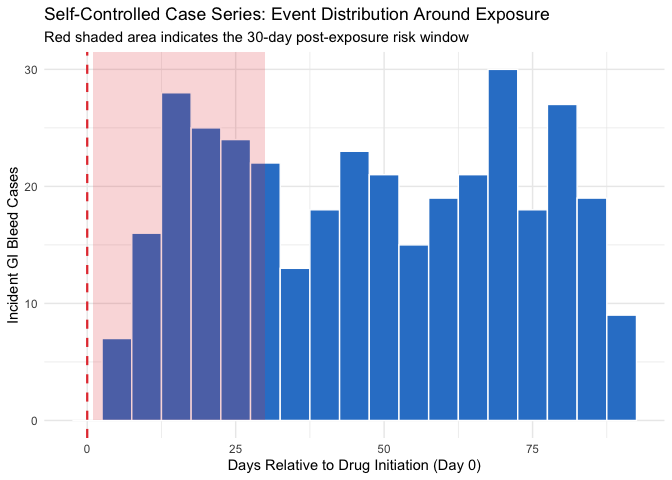
A fundamental diagnostic step in SCCS studies is plotting the distribution of events relative to the index exposure date to evaluate whether outcomes cluster within the hypothesized acute risk window:
# Plot event distribution relative to exposure initiation (Day 0)
ggplot(cases |> filter(abs(rel_day) <= 90), aes(x = rel_day)) +
  geom_histogram(binwidth = 5, fill = "#3182ce", color = "white") +
  geom_vline(xintercept = 0, linetype = "dashed", color = "#e53e3e", linewidth = 0.8) +
  annotate("rect", xmin = 1, xmax = 30, ymin = 0, ymax = Inf, alpha = 0.2, fill = "#e53e3e") +
  labs(
    title = "Self-Controlled Case Series: Event Distribution Around Exposure",
    subtitle = "Red shaded area indicates the 30-day post-exposure risk window",
    x = "Days Relative to Drug Initiation (Day 0)",
    y = "Incident GI Bleed Cases"
  ) +
  theme_minimal()
Step 5: Risk Window vs. Control Window Comparison
We partition the case follow-up into a 30-day post-exposure risk window ($[+1, +30]$ days) and balanced 30-day pre-exposure ($[-60, -31]$ days) and post-risk ($[+31, +60]$ days) control windows:
n_cases <- length(unique(cases$person_id))
n_risk <- sum(cases$rel_day >= 1 & cases$rel_day <= 30)
n_control_pre <- sum(cases$rel_day >= -60 & cases$rel_day <= -31)
n_control_post <- sum(cases$rel_day >= 31 & cases$rel_day <= 60)

comparison_df <- data.frame(
  Window = c(
    "Pre-exposure Control (-60 to -31 days)",
    "Acute Risk Window (+1 to +30 days)",
    "Post-exposure Control (+31 to +60 days)"
  ),
  Duration_Days = c(30, 30, 30),
  Events_N = c(n_control_pre, n_risk, n_control_post),
  Person_Days = c(n_cases * 30, n_cases * 30, n_cases * 30),
  Rate_Per_1000_Days = c(
    (n_control_pre / (n_cases * 30)) * 1000,
    (n_risk / (n_cases * 30)) * 1000,
    (n_control_post / (n_cases * 30)) * 1000
  )
)

comparison_df |>
  gt() |>
  tab_header(
    title = "Self-Controlled Case Risk Interval Comparison",
    subtitle = "Celecoxib Exposure vs Acute GI Bleeding"
  ) |>
  cols_label(
    Window = "Analysis Window",
    Duration_Days = "Duration (Days)",
    Events_N = "Observed Events (N)",
    Person_Days = "Person-Days at Risk",
    Rate_Per_1000_Days = "Event Rate (per 1,000 Person-Days)"
  ) |>
  fmt_number(columns = "Rate_Per_1000_Days", decimals = 2)
| Self-Controlled Case Risk Interval Comparison | ||||
| Celecoxib Exposure vs Acute GI Bleeding | ||||
| Analysis Window | Duration (Days) | Observed Events (N) | Person-Days at Risk | Event Rate (per 1,000 Person-Days) |
|---|---|---|---|---|
| Pre-exposure Control (-60 to -31 days) | 30 | 0 | 10650 | 0.00 |
| Acute Risk Window (+1 to +30 days) | 30 | 113 | 10650 | 10.61 |
| Post-exposure Control (+31 to +60 days) | 30 | 112 | 10650 | 10.52 |